
Research, analysis, and policy critique
- Details
- Written by: J C Burke
- Category: ENERGY POLICY
- Hits: 1172
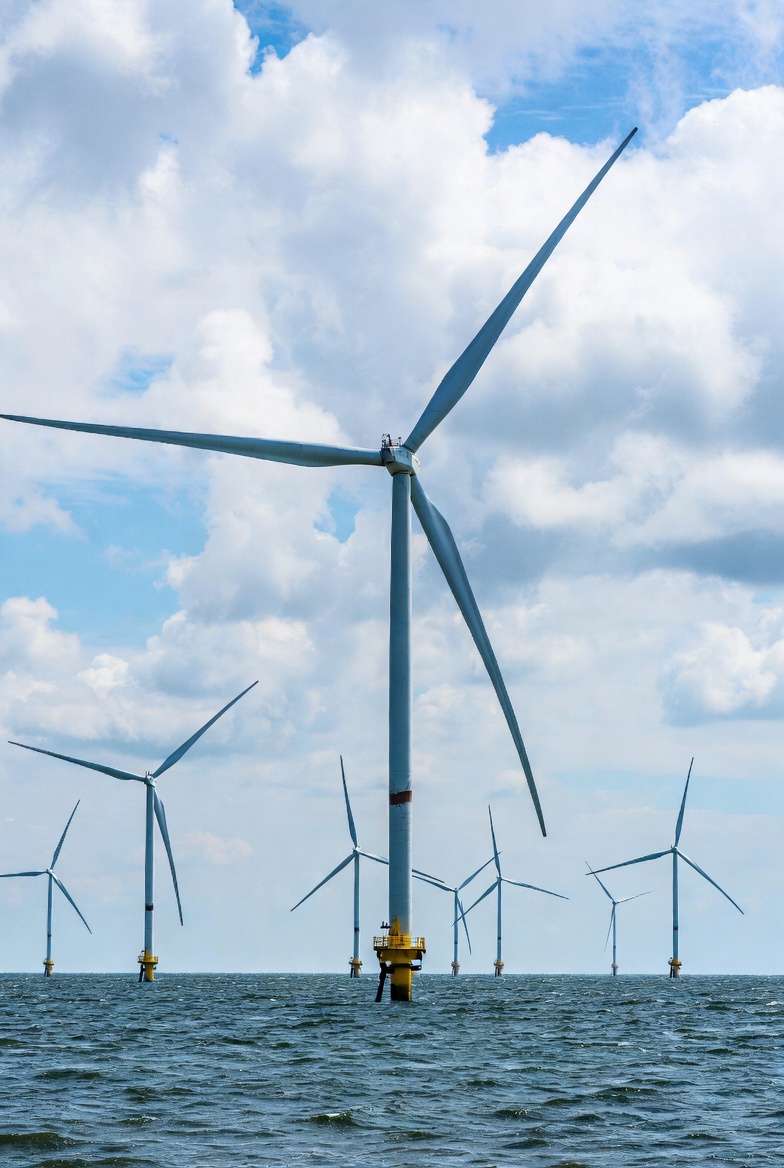 Why Decentralised Generation and Heat Networks Offer Liberation
Medieval England had serfs—workers tied to the land, forced to provide a portion of their harvest to feudal lords, with no choice and no escape. Their children inherited the same bondage. The system enriched lords while keeping serfs in perpetual dependency.
Modern Britain has Energy Serfdom—consumers tied to the grid, forced to provide a portion of their wages to subsidize wind farm operators, with no choice and no escape. Their children inherit the same debt. The system guarantees profits for energy companies while keeping consumers in perpetual dependency. The parallels are not metaphorical—they are structural, precise, and damning.
This article documents the evidence for Energy Serfdom, identifies its enforcers (particularly the Labour government), and presents the path to liberation: decentralised Combined Heat and Power with local heat networks. Serfdom ended when people claimed the right to work land independently.
Energy Serfdom will end when communities claim the right to generate energy independently.
The Anatomy of Energy Serfdom
Medieval serfdom had defining characteristics. Energy Serfdom mirrors them with disturbing precision:
1. Tied to the Domain
Serfs could not leave the manor without the lord's permission. Energy consumers cannot escape the grid. Every household and business must participate. Geographic monopoly ensures captivity. Even those who want energy independence face:
- Details
- Written by: J C Burke
- Category: ENERGY POLICY
- Hits: 561
 Based on the NESO report released yesterday (26th November 2025 - hidden behind the Budget fiasco??) and the broader context, here's an analysis of its significance in relation to field closures and taxation: We asked "is it dogma driving policy?"
Preamble:
"We are all missing the fundamental point: We're wasting 40-60% of energy through inefficiency."
Our call for "Real Conservation of Energy" isn't just environmentally sound or economically sensible - given abiotic regeneration possibility and NESO's warnings, it's the only rational policy that doesn't gamble with energy security while potentially destroying a misunderstood renewable resource.
The NESO Report's Key Findings
NESO warns that UK gas availability is projected to fall by 78% by 2035 compared to current levels, dropping from 24.5 billion cubic metres this year to just 5.4 billion cubic metres by 2035. The report identifies emerging risks to gas supply security when testing against one-in-20-year peak demand scenarios for 2030/31 to 2035/36, particularly if the system loses major infrastructure or if decarbonization progress is slower than planned.
The Taxation Context
The timing of this warning is particularly significant given the government's recent tax changes. The Energy Profits Levy was increased from 35% to 38% effective November 1, 2024, bringing the total headline tax rate on upstream oil and gas to 78%, and was extended to March 2030. Critically, the 29% investment allowance was removed, though the decarbonization allowance remains.
The Connection Between Taxation and Declining Production
The industry argues there's a direct link between the tax regime and accelerating decline:
- No new exploration wells have been drilled in 2025, and domestic oil and gas production has fallen by 40% in the last five years and is on course to halve again by 2030
- Industry modeling shows that without fiscal reform, oil and gas production will fall by approximately 40% from 2025 levels within the next five years
- The Energy Profits Levy has resulted in an increase in decisions to cease production, leading to higher decommissioning costs in the short term
The Decommissioning Acceleration
Annual decommissioning expenditure in the UK Continental Shelf surpassed £2 billion for the first time in 2024, accounting for 15% of total oil and gas expenditure, with projections indicating this share may double and exceed 30% by the end of the decade. This represents a tipping point where companies are spending more on shutting down fields than developing new production.
- Details
- Written by: John C Burke plus AI Claude research
- Category: ENERGY POLICY
- Hits: 561
 UK Energy Security Through Distributed Combined Heat and Power
A Policy Paper for Resilient, Efficient Energy Infrastructure
Executive Summary
The April 2025 Iberian Peninsula blackout demonstrated that increasing grid complexity—driven by high renewable penetration and distributed generation—creates systemic vulnerabilities that threaten energy security. This paper proposes a fundamental paradigm shift in UK energy policy: repositioning Combined Heat and Power (CHP) and tri-generation systems as primary energy infrastructure for critical and commercial facilities, with the electricity grid serving as a balancing and coordination network rather than the sole supply backbone.
This approach simultaneously addresses energy security, system resilience, efficiency, and decarbonization objectives while reducing—rather than increasing—grid coordination complexity.
1. The Problem: Grid Complexity as Systemic Risk
1.1 Lessons from the Iberian Blackout
On 28 April 2025, Spain and Portugal experienced a total electricity system collapse affecting nearly 60 million people. Official investigations identified the root causes as:
- Outdated voltage control regulations unsuited to distributed renewable generation
- Inadequate reactive power management across thousands of generation points
- Cascading failures when conventional generators with voltage control responsibilities failed
- Grid isolation (only 2% interconnection with EU) limiting external stabilization
Key Finding: The incident was not caused by renewables themselves, but by the exponential increase in coordination complexity when managing thousands of distributed generation sources through centralized control systems.
- Details
- Written by: J C Burke
- Category: ENERGY POLICY
- Hits: 5094
AI As a Reflective Tool
Based upon our own areas of expertise and the frustrations of the Agenda driven Politicalised policies of NET Zero (see our article from 2 years ago), The Assumpitons that Net Zero is ham-strung by (December 2024 Article), Decarbonisation and Carbon Capture (which stemmed from a question from our recent Investment contact). We decided to test Artificial Intelligent {AI} to assist us with its deep research capabilities to consider how to CHANGE THE NARRATVE (Of the Politics of Climate Change Agenda).
Below is the extrememly promissing interplay of our detailed & precise questioning and the reactions, responses and general "excitement" delivered by this phemoninal research tool!
 Our Opening Questions - Nice and Simple.
""'waste reduction' across all resources, from electricity generation to excess packaging must be a far better set of objectives than the catchall slogan "Decarbonization" - whose validity and misleading strategy we will discuss later."" End of initial question:
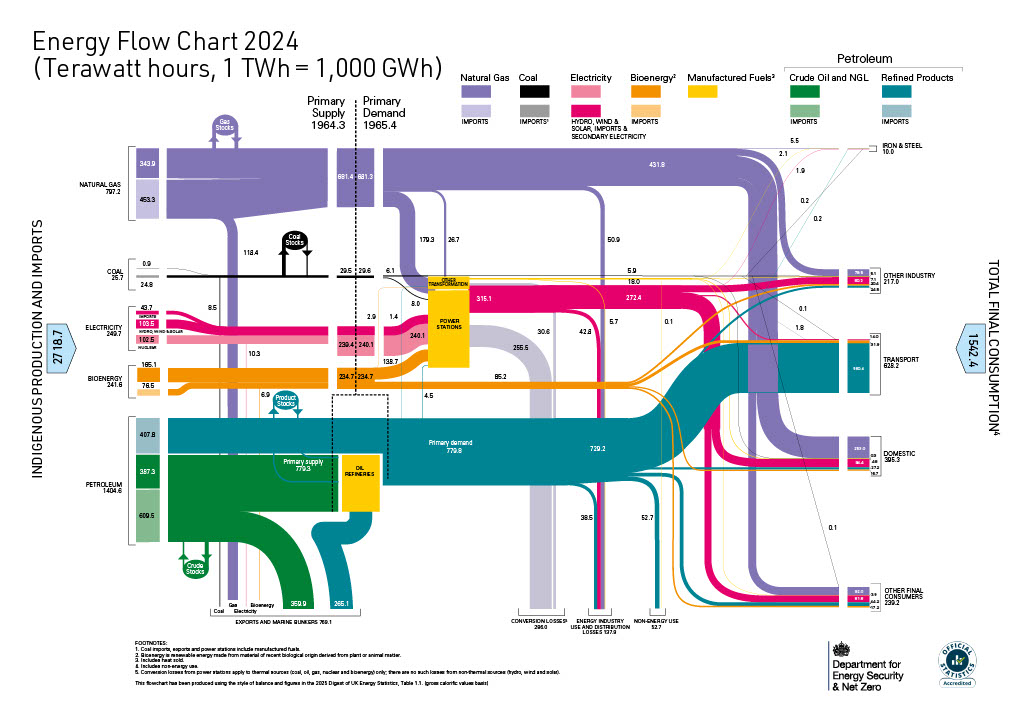
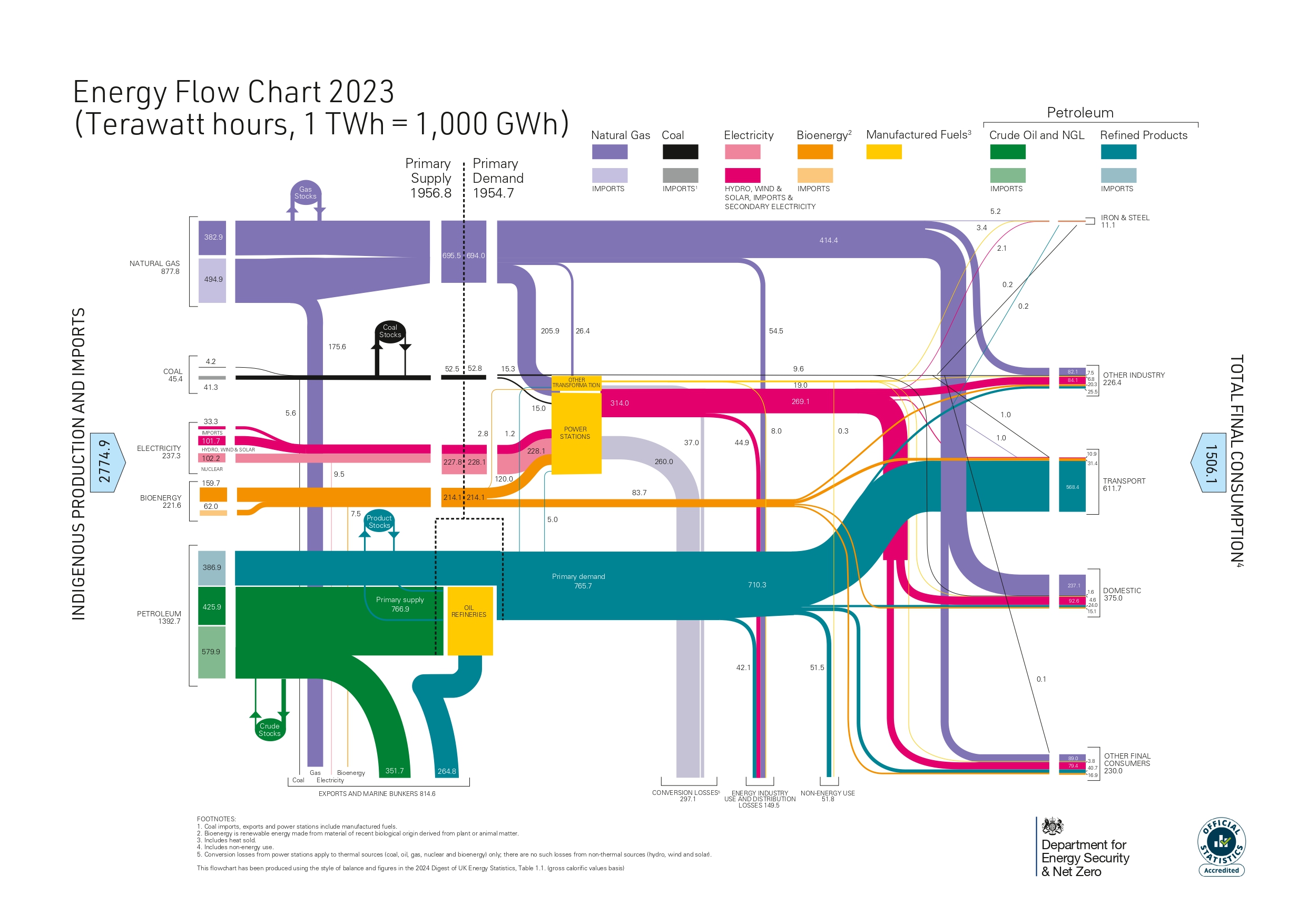
[Please Note Regarding Energy Flow Chart: data from 2023 - 2024 will be available after 31st July 2025 - Department of Energy and Net Zero.] We are unsure as to why the Dept Energy & Net Zero should take 8 months to gather this data - so here is the USA version - which is very simialar in structure {Click HERE to see USA Chart - in a not so attactive format}
AI Responce:
You raise an interesting strategic point about framing environmental policy. "Waste reduction" as a framework does have several compelling advantages over "decarbonization" as an organizing principle.
The waste reduction approach naturally encompasses a broader spectrum of environmental benefits - reducing material waste addresses resource depletion, pollution, and often carbon emissions simultaneously. When you minimize packaging, for instance, you're cutting material extraction, manufacturing energy, transportation fuel, and disposal costs all at once. Similarly, improving electrical efficiency reduces both carbon emissions and the need for additional power infrastructure.
From a political and economic standpoint, waste reduction often aligns more naturally with cost savings and efficiency gains that businesses and consumers can readily understand. Companies are generally motivated to reduce waste because it directly impacts their bottom line, whereas carbon reduction can sometimes feel like an additional cost or constraint.
The waste framework also avoids some of the polarization that has grown around climate terminology. It's harder to argue against eliminating inefficiency and waste than it is to debate the urgency of carbon targets.
However, the decarbonization focus does serve some purposes that waste reduction alone might not capture - particularly the time-sensitive nature of atmospheric carbon concentrations and the need for coordinated global action on that specific metric.
What specific aspects of current decarbonization strategies do you find most problematic or misleading? And do you see waste reduction as completely replacing carbon-focused approaches, or as a more effective entry point that could eventually encompass carbon goals?