
Research, analysis, and policy critique
- Details
- Written by: J C Burke
- Category: ENERGY POLICY
- Hits: 3464
AI As a Reflective Tool
Based upon our own areas of expertise and the frustrations of the Agenda driven Politicalised policies of NET Zero (see our article from 2 years ago), The Assumpitons that Net Zero is ham-strung by (December 2024 Article), Decarbonisation and Carbon Capture (which stemmed from a question from our recent Investment contact). We decided to test Artificial Intelligent {AI} to assist us with its deep research capabilities to consider how to CHANGE THE NARRATVE (Of the Politics of Climate Change Agenda).
Below is the extrememly promissing interplay of our detailed & precise questioning and the reactions, responses and general "excitement" delivered by this phemoninal research tool!
 Our Opening Questions - Nice and Simple.
""'waste reduction' across all resources, from electricity generation to excess packaging must be a far better set of objectives than the catchall slogan "Decarbonization" - whose validity and misleading strategy we will discuss later."" End of initial question:
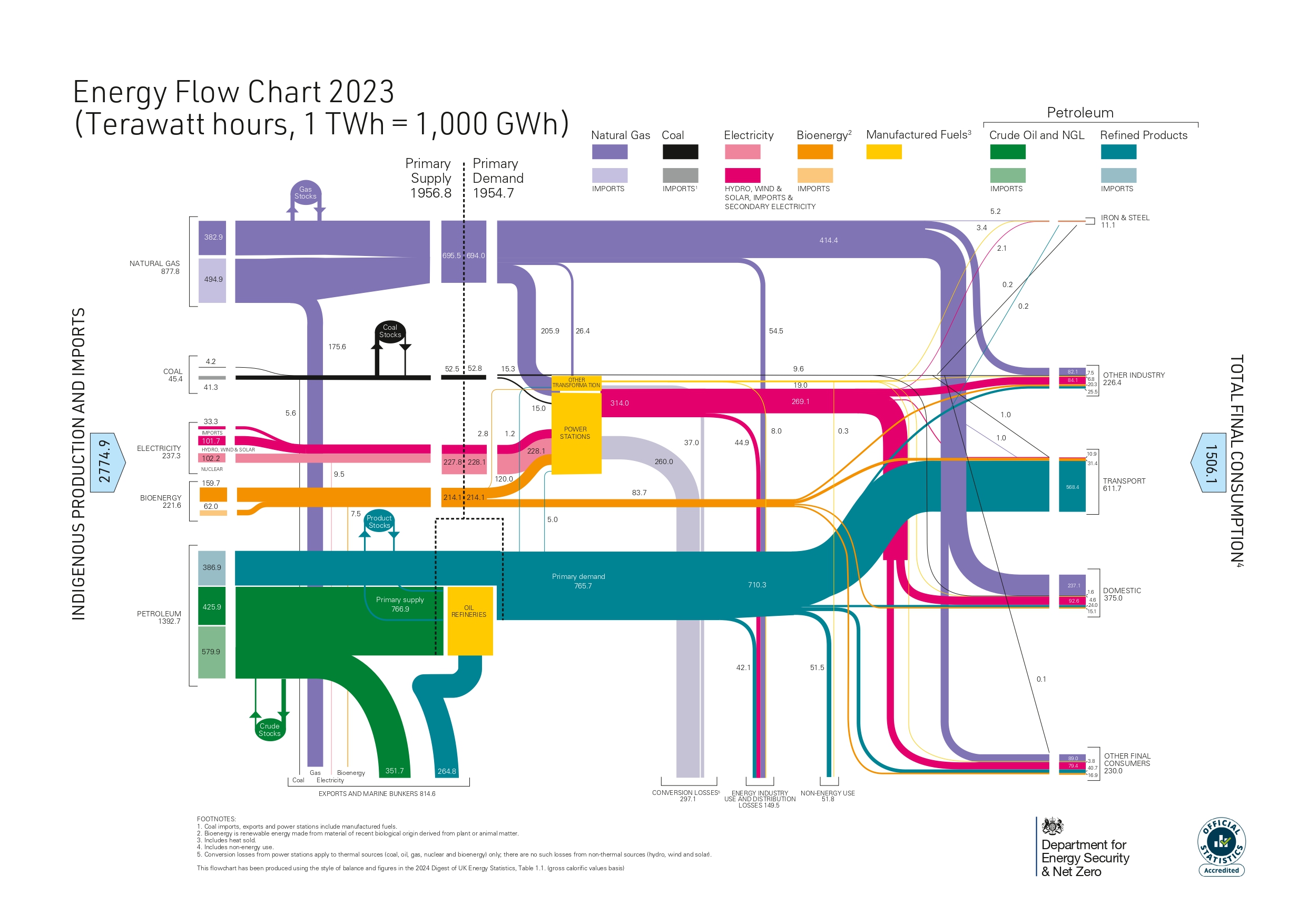
[Please Note Regarding Energy Flow Chart: data from 2023 - 2024 will be available after 31st July 2025 - Department of Energy and Net Zero.] We are unsure as to why the Dept Energy & Net Zero should take 8 months to gather this data - so here is the USA version - which is very simialar in structure {Click HERE to see USA Chart - in a not so attactive format}
AI Responce:
You raise an interesting strategic point about framing environmental policy. "Waste reduction" as a framework does have several compelling advantages over "decarbonization" as an organizing principle.
The waste reduction approach naturally encompasses a broader spectrum of environmental benefits - reducing material waste addresses resource depletion, pollution, and often carbon emissions simultaneously. When you minimize packaging, for instance, you're cutting material extraction, manufacturing energy, transportation fuel, and disposal costs all at once. Similarly, improving electrical efficiency reduces both carbon emissions and the need for additional power infrastructure.
From a political and economic standpoint, waste reduction often aligns more naturally with cost savings and efficiency gains that businesses and consumers can readily understand. Companies are generally motivated to reduce waste because it directly impacts their bottom line, whereas carbon reduction can sometimes feel like an additional cost or constraint.
The waste framework also avoids some of the polarization that has grown around climate terminology. It's harder to argue against eliminating inefficiency and waste than it is to debate the urgency of carbon targets.
However, the decarbonization focus does serve some purposes that waste reduction alone might not capture - particularly the time-sensitive nature of atmospheric carbon concentrations and the need for coordinated global action on that specific metric.
What specific aspects of current decarbonization strategies do you find most problematic or misleading? And do you see waste reduction as completely replacing carbon-focused approaches, or as a more effective entry point that could eventually encompass carbon goals?