
An Holistic Approach to City Re-Development
- Details
- Written by: J C Burke
- Category: PROJECTS & INVESTMENT
- Hits: 2904
AI Sys: AND Based on My Experience
1. Context of Centralized vs. Decentralized Electricity Production
Centralized Electricity Production:
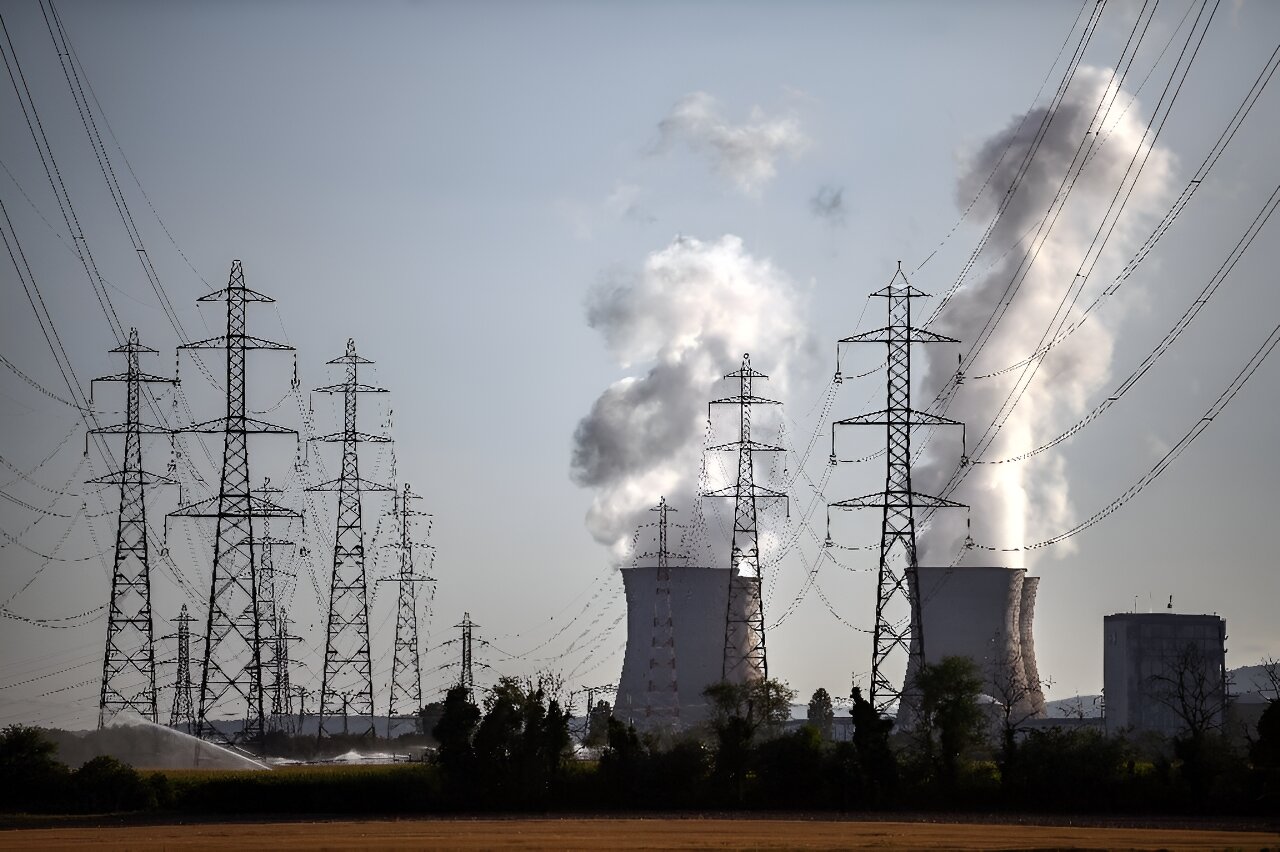 In the UK, electricity is predominantly generated by large-scale centralized power stations (e.g., gas-fired Combined Cycle Gas Turbines (CCGT), nuclear plants, and large renewable installations like offshore wind farms).
- These plants are typically located far from urban centres, leading to significant transmission and distribution losses (approximately 7-10% of generated electricity is lost in the grid).
- Centralized systems are designed primarily for electricity generation, and waste heat (e.g., from gas or nuclear plants) is often dissipated into the environment rather than utilized, resulting in low overall fuel utilization efficiency (typically 40-50% for CCGT plants, though some modern plants can reach 60%).
Decentralized Electricity Production:
- Decentralized systems involve smaller-scale generation units (e.g., Combined Heat and Power (CHP) plants, microgrids, local renewables) located closer to end-users.
- These systems can utilize waste heat from electricity generation for heating purposes via heat networks (district heating), significantly increasing overall fuel utilization efficiency (up to 80-90% in well-designed CHP systems).
- Decentralized systems can also integrate local renewable energy sources (e.g., solar PV, small wind turbines) and energy storage technologies, including heat storage.
2. Fuel Utilization Efficiencies
One of the primary benefits of moving to decentralized electricity production, coupled with heat networks, is the dramatic improvement in fuel utilization efficiency. Here's how:
- Centralized Systems:
- In a typical centralized CCGT plant, electricity is generated with an efficiency of around 50-60%. The remaining energy is lost as waste heat, often vented to the atmosphere or dissipated into water bodies.
- If natural gas is used solely for electricity generation, the overall system efficiency is limited to this range, and additional gas or electricity is required to meet heating demands (e.g., via domestic gas boilers or electric heating), further compounding energy losses.
- Decentralized Systems with CHP and Heat Networks:
- In a decentralized CHP system, the same amount of natural gas can be used to generate both electricity and heat. Modern CHP systems can achieve overall efficiencies of 80-90%, as waste heat is captured and distributed via heat networks to provide space heating, hot water, or industrial process heat.
- For example, a CHP plant generating 40% electricity and capturing 45% of the energy as usable heat achieves an overall efficiency of 85%, compared to 50% in a centralized system where heat is not utilized.
- This higher efficiency reduces the total amount of fuel (e.g., natural gas) required to meet the same electricity and heating demands, directly lowering fuel costs and reducing exposure to volatile gas prices.
- Economic Implications:
- By reducing fuel consumption, decentralized systems lower the operational costs of energy production. For instance, if a CHP plant requires 15-20% less gas to deliver the same energy services (electricity + heat) as a centralized system, this translates into significant savings, especially given the high cost of natural gas in the UK.
- Additionally, the reduced reliance on grid electricity (subject to transmission losses and high retail tariffs) further lowers costs for end-users.
It’s almost science fiction
- Details
- Written by: Mindy Weisberger, CNN
- Category: Alternative Energy
- Hits: 2817
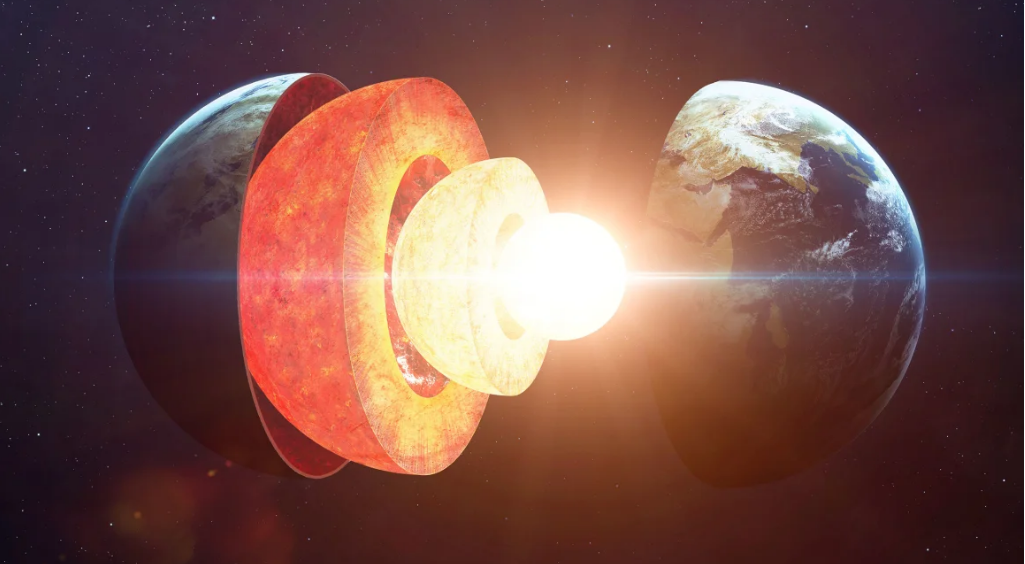 ‘It’s almost science fiction’: Scientists say the shape of Earth’s inner core is changing
By Mindy Weisberger, CNN Mon February 10, 2025CNN Science Original CNN Science Article
Link to Research in Nature AND Associated Research Link to Associated Research
""Abstract
The inner core has been inferred to change its rotation rate or shape over years to decades since the discovery of temporal variability in seismic waves from repeating earthquakes that travelled through the inner core. Recent work confirmed that the inner core rotated faster and then slower than the rest of Earth in the last few decades; this work analysed inner-core-traversing (PKIKP) seismic waves recorded by the Eielson (ILAR) and Yellowknife (YKA) arrays in northern North America from 121 repeating earthquake pairs between 1991 and 2023 in the South Sandwich Islands. Here we extend this set of repeating earthquakes and compare pairs at times when the inner core re-occupied the same position, revealing non-rotational changes at YKA but not ILAR between 2004 and 2008. We propose that these changes originate in the shallow inner core, and so affect the inner-core-grazing YKA ray paths more than the deeper-bottoming ray paths to ILAR. We thus resolve the long-standing debate on whether temporal variability in PKIKP waves results from rotation or more local action near the inner-core boundary: it is tentatively both. The changes near the inner-core boundary most likely result from viscous deformation driven by coupling between boundary topography and mantle density anomalies or traction on the inner core from outer-core convection.""
CNN Science Article —
Scientists who just months ago confirmed that Earth’s inner core recently reversed its spin have a new revelation about our planet’s deepest secrets — they identified changes to the inner core’s shape. Earth’s innermost layer is a hot, solid ball of metal surrounded by a liquid metal outer core. For decades, planetary scientists suspected that the solid inner core deformed over time as it spun. Now, researchers have found the first evidence of changes taking place over the past 20 years in the shape of the inner core.
Signs of the core’s deformation appeared in waves from earthquakes that were strong enough to reach Earth’s centre. The research team used that same earthquake data for a 2024 study to resolve a longstanding debate over the inner core’s rotation. They found that the inner core once spun faster than Earth itself. But beginning around 2010, the solid inner core’s spin slowed. It’s now revolving backward, relative to the rest of the planet.
Greenhouse Effect - Theory or Proven?
- Details
- Written by: Ned Nikolov and Karl F Zeller
- Category: Climate Science
- Hits: 3049
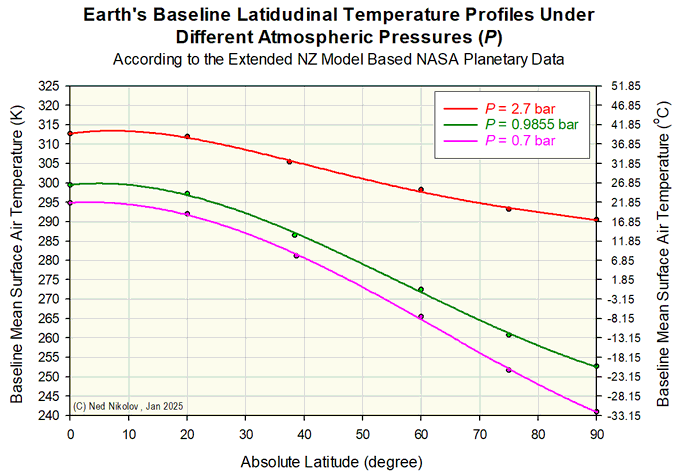 {See Ned Nikolov} "Ever wondered, what the Earth's surface temperatures would be under different atmospheric pressures?"
"This graph shows results from the latest extended NZ planetary temperature model based on the best available NASA data for Venus, the Moon, Earth, Mars, Titan and Triton. These planetary bodies were used to derive universal thermodynamic relationships (valid over a huge range of physical environments) between surface temperatures one hand and pressure, atmospheric density & incoming solar radiation on the other."
"The predictions for Earth depicted here are so accurate that you can take them to bank, as the saying goes."
The green curve shows average latitudinal temperatures under the current pressure (0.9855 bar).
"The overall pattern is that an increasing atmospheric pressure raises the mean global temperature while reducing the latitudinal temperature gradients at the same time. Thus, the higher the total pressure, the more isothermal the planet becomes! That's because molar air density increases with pressure, and a higher density makes the meridional heat transport more efficient due to the presence of large number of molecules per cubic meter carrying heat. Venus with its 93 bar of surface pressure is an example of an isothermal planet surface caused by a very high atmospheric molar density... The relationships are strongly non-linear, however."
Full Research Thesis Click HERE
Net Zero and Dangerous Assumptions
- Details
- Written by: J C Burke
- Category: Net Zero Critique
- Hits: 3826
 The Net Zero Acolytes have got it all wrong! And its not Just Us - NetZeroWatch
My Christmas/New Year Message {a Present} to You - the general population and our 'deaf' Government See Letter to Dept of Energy & Net Zero
Government reliance on CENTRALISED power {electricity} generation is part of the root of their poor assumptions. It's the default position of 'Government' to think of CENTRALISATION - and that's just one problem that we will discuss in detail below. But Centralised Electricity Generation {gas/coal/bio-mass etc} is surprisingly inefficient - at converting fuel into electricity. Coal was the least efficient at 22%, with various Gas engines getting into the 30-35% fuel conversion efficiencies.
BUT the reason is the HEAT produced - is "squandered" up those Cooling Towers - if you read our previous articles you will see the futility of the Centralised Electricity Strategy - when there are clear, inexpensive and energy efficient alternatives {see later}.
The other assumptions {re Net Zero}, we have brought to your attention before in these articles on this platform Net Zero - They Haven't Got a CLUE and Again Net Zero - Cold Feet and the biggest question about "Fossil Fuels" a known misnomer
But, let us return to our interrogation with AI - Chat GPT in this case back in March 2023. Here we had to cajole AI into at least considering the alternatives {for once} and not being influenced by continued agenda politics {as we are again being subjected to in late 2024 and as it appears well into 2025. It has to STOP - as the Nation is being herded in the wrong direction - by politics and NOT Science. Read our Discussions with Chat GPT about Electricity Generation HERE
Once you read that - it's patently obvious that in order to radically improve Fuel Efficiency, we need to move to localised DECENTRALISED ENERGY {plus attendant Heat Networks}. For good strategic reasons -
- energy resilience,
- grid embedded energy and
- far greater energy efficiency.
Factor in, Bio-Methane production from Organic Waste Streams to power such decentralised systems then we have ENERGY AUTONOMY at the local level.
Decentralised Solar vs Centralised Solar
- Details
- Written by: J C Burke
- Category: UK Energy Security
- Hits: 3512
...Equally applies to wind, hydro as well
From the US they have noticed the problems with Industrial scale Renewables, the Grid and Instability.
"As the U.S. begins a major push to become the leading player in the global solar revolution, the topic of sprawling solar farms built away from communities vs. small and medium scale solar arrays utilising rooftops and smaller parcels of already developed or degraded land is becoming an increasingly important issue."
"Small and medium scale solar power has the potential to become the Internet of distributed electricity generation – a network resilient to a single point of failure; whether caused by natural disasters or attack by hostile parties."
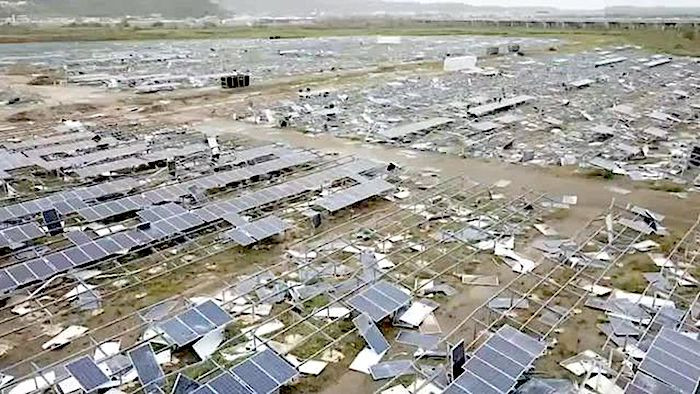 But this aspect only scratches the surface – decentralised solar {as well as Wind and Hydro} power offers a multitude of other benefits over large scale plants;
- including avoiding “line loss” and heat losses from transformers, associated with remote generation,
- reduction in infrastructure investment {GRID}
- while offering major permanent job creation potential and
- avoiding damage to wildlife habitats, loss of farmlands.
Instead of appropriating undisturbed public lands or utilising productive agricultural land for solar power generation on a massive scale, better use can be made of the very much under-utilised sea of rooftops in our towns and cities. Furthermore, in the UK the brownfield sites, commercial buildings within ctown/city centres offers direct in-building benefits.
Page 5 of 11